Formex built its reputation on a specific kind of watch. Ergonomic. Technically clever. Swiss-made but priced like the brand had something to prove against established names. The Essence, the Reef, the Stratos — each made a coherent argument for spending a few hundred to a couple thousand dollars on a watch from a company you'd never heard of. The argument usually worked, and the brand accumulated a loyal following that appreciated functional design without boutique-hotel markup.
The ARIA Manufacture Chronometer is a different kind of watch. It is not in that price bracket. It is not making that argument. And it arrives with two things Formex has never done before: an integrated bracelet and a proprietary movement.
Whether that combination at EUR 7,600 is an evolution or an overreach is exactly the question the brand is betting it can answer.
What the ARIA Is
The case is 40mm Grade 5 titanium, 6.9mm thick from caseback to crystal. Lug-to-lug is 45.45mm. The whole assembled watch — bracelet and all — weighs 78 grams. These are numbers that don't fully land until you hear them together: 6.9mm thin is ultra-thin territory for an automatic sports watch. For context, the Tissot PRX, one of the most popular integrated-bracelet references in recent years, runs around 11mm thick. The Omega Aqua Terra is thicker still. At 6.9mm, the ARIA is closer in profile to a dress watch than to its direct sporting competitors, which is either a design achievement or a positioning miscalculation, depending on what you believe an integrated bracelet watch should feel like on the wrist.
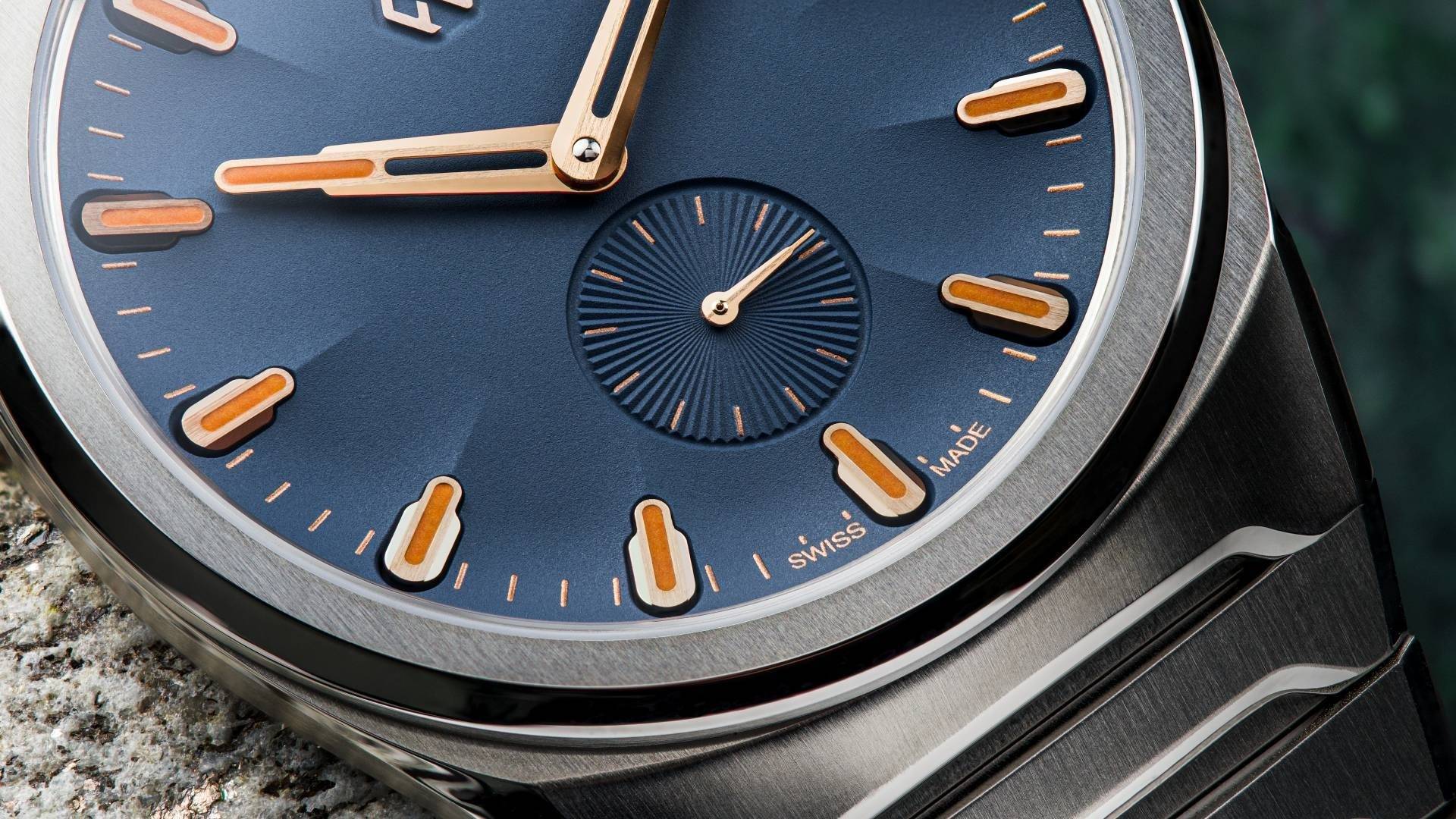
The lines are soft and rounded — a deliberate departure from Formex's historically more industrial aesthetic. Brushed and polished surfaces alternate in a way that creates movement without loudness. The dial is stamped from brass and matte lacquered in one of three finishes: Denso Blue, a deep navy; Selva Green, a warm, organic tone; and Ardesia Grey, which reads as mineral and cool. Applied indices are rose-gold toned with concave sections that create depth and catch light differently depending on angle. The hands match.
It is an elegant watch. It does not look like previous Formex watches, and that's clearly intentional.
The First Integrated Bracelet
Every brand that has ever made a lug-and-strap watch knows the moment when an integrated bracelet becomes possible to discuss seriously: it's when the design vocabulary of the case and the clasp mechanism actually connect into something coherent, rather than a bracelet bolted to a case that doesn't quite want one.
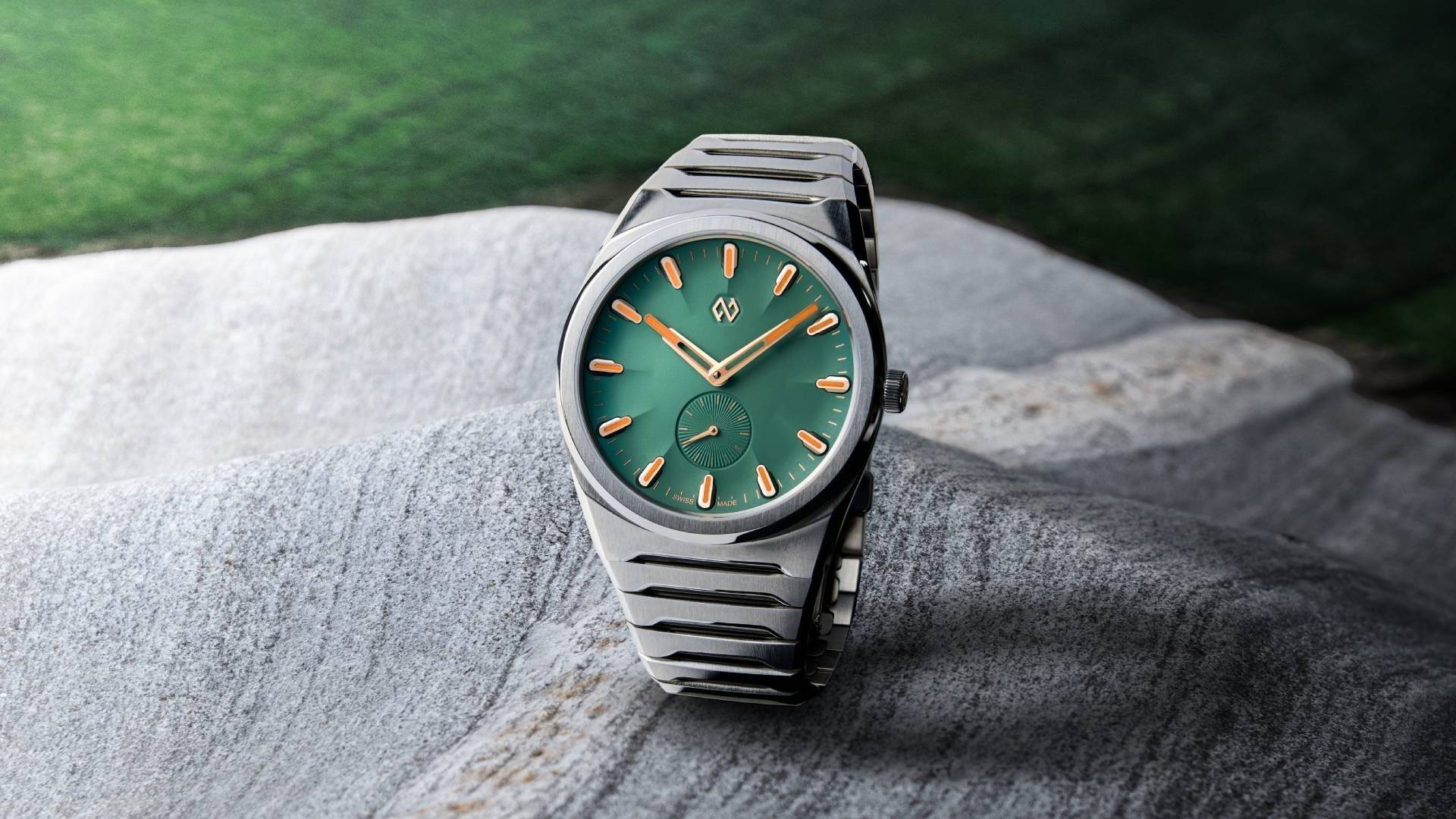
The ARIA's integrated titanium bracelet uses quick-release end links and a double-folding clasp with Formex's patented micro-adjustment system — 3mm of adjustment on each side, without removing the watch. This is not a new idea (Rolex's Glidelock, AP's system, Tudor's T-Fit all do versions of this), but it is an idea that matters on a bracelet watch: the case and bracelet are one architectural object, and the clasp needs to treat that object seriously.
Formex has done integrated bracelets on no previous production model. The ARIA is the first. The bracelet's proportions and the integrated end-link execution are where a brand either earns or loses credibility in this category — fit, flow, how the bracelet sits at the wrist, whether the end links create an uninterrupted line from case to band. On paper it reads well. Whether it holds up against watches that have spent decades iterating on exactly this problem is something only wrist time will settle.
The Movement: FX01 with Horage
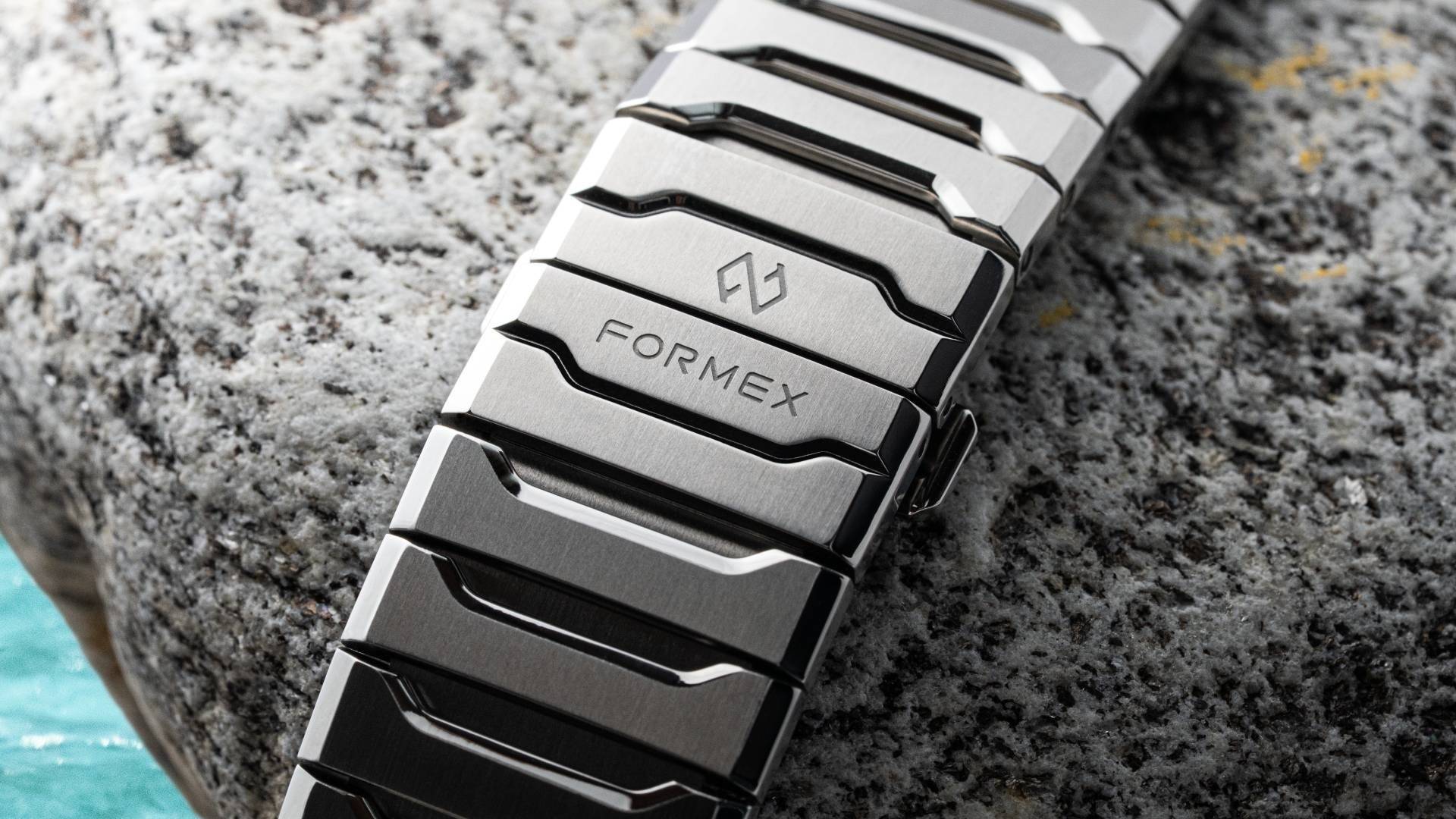
The calibre FX01 is the other first here. Formex has never sold a watch with a proprietary movement. The FX01 was developed in collaboration with Horage, the Swiss independent best known for its K2 micro-rotor platform — the same architecture at the FX01's core.
The specification is serious: 30mm diameter, 2.9mm thick movement. Tungsten micro-rotor. Silicon hairspring, escape wheel, and pallet fork, which means antimagnetic and free-sprung regulation. A flexible geartrain pinion for backlash-free hand setting — a detail that matters in day-to-day use more than it sounds, eliminating the slop that can make setting the time on a finely toleranced movement feel imprecise. 25 jewels. 25,200vph (3.5Hz). 72 hours of power reserve. COSC-certified chronometer.
The movement is finished with black-gold galvanic treatment on the bridges with vertical brushing, visible through the sapphire caseback. For a brand releasing its first manufacture movement, the specification list is not hedged. They have not chosen a middling calibre and called it proprietary. Whether co-developed with Horage constitutes "in-house" is a reasonable question — Horage provided the base platform, Formex owns the variant — but the result is a calibre that does not exist in any other watch.
Three Dials, One Idea
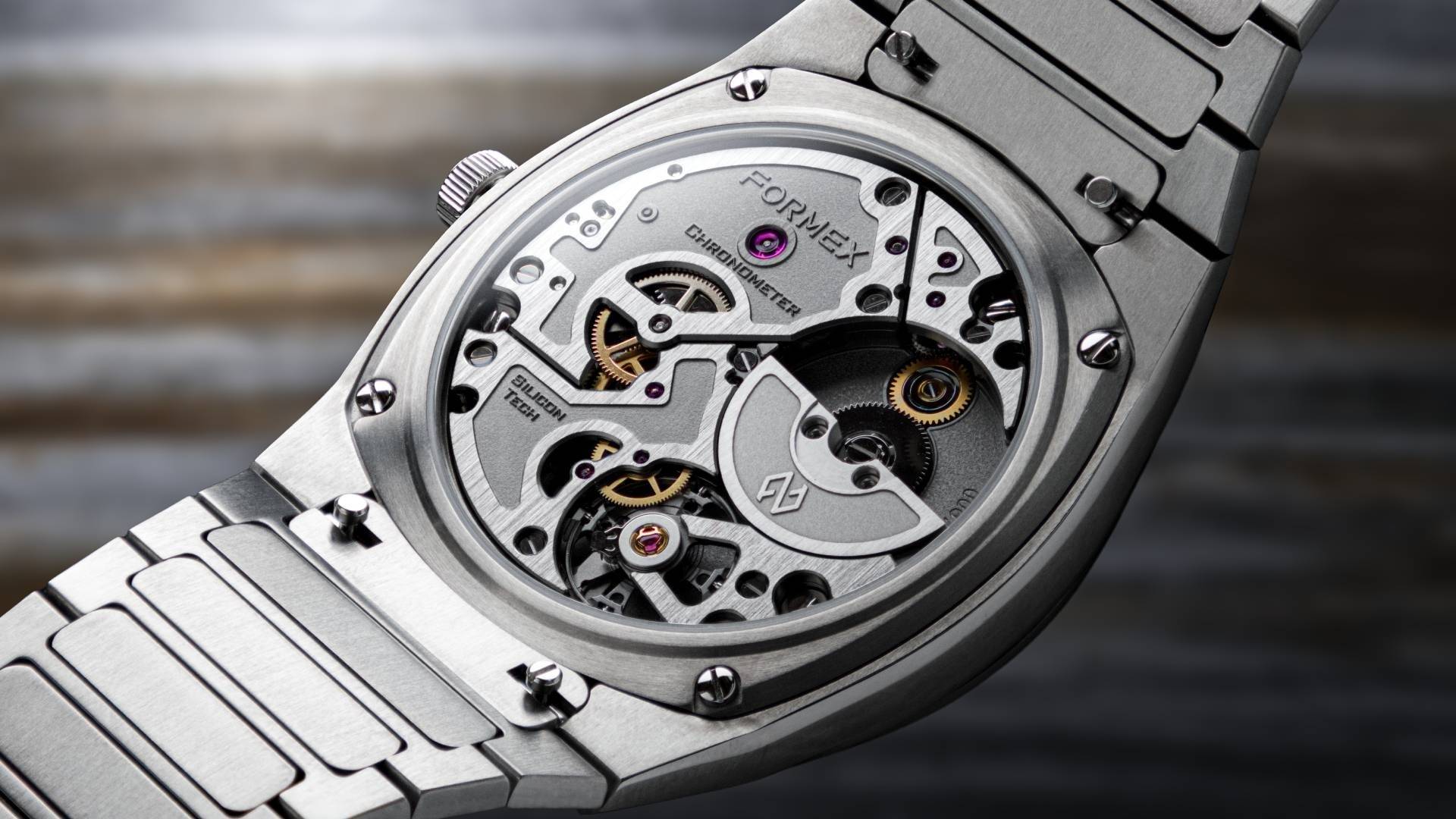
The launch comes in three references, differentiated entirely by dial color: Denso Blue, Selva Green, and Ardesia Grey. The case, bracelet, dimensions, and movement are identical across all three.
Denso Blue is the most legible at a glance — navy depth with the rose-gold indices reading clearly against the dark field. Selva Green is the one that will photograph best and age most interestingly; warm, earthy greens in the integrated-bracelet category are still relatively uncommon at this price tier. Ardesia Grey is the most reserved, the one that will slip past a dress code without comment.
All three use the same applied index construction and matching hands. There are no text sub-dials, no date, no clutter. For a COSC-certified chronometer — a movement held to stricter timekeeping tolerances than a standard automatic — the clean two-hand dial is a deliberate choice: the precision is in the movement, not on the face.
The Price and What It Means
Formex's previous flagship pieces sold for under €2,000. The ARIA launches at EUR 7,600 / USD 7,900 / CHF 5,900.
That is not an incremental price increase. It is a signal that the brand is repositioning itself in a segment occupied by Nomos, Mido's upper tier, microbrand competitors like Farer or Baltic, and — at the far end of the same argument — the entry-level offerings from brands like Longines and Tudor. More pointedly, it puts Formex in a conversation with watches from Nomos Glashütte Orion and Tangente, or from Tudor's Pelagos 39, where brand heritage, established aesthetic vocabulary, and decades of production refinement are the implicit justification for the price.
Formex is asking buyers to value the technical specification — the ultra-thin manufacture movement, the COSC certification, the titanium construction — over the weight of an established name. For a segment of buyers, that's a coherent proposition. The FX01's silicon regulating organ and COSC certification are objectively stronger specifications than what you find in competing automatic integrateds at this price. Titanium at this thickness, with this movement, from a Swiss independent: the parts list is defensible.
The risk is that integrated bracelet sports watches at this price tier carry expectation beyond the parts list. Brand story, aesthetic legacy, distribution and service infrastructure, resale trajectory — these are the things that EUR 7,600 buyers weigh alongside the movement spec, and they are the things Formex is still building.
The ARIA launches as a 100-piece Founders Edition, with deliveries scheduled for September 2026. That limited first run is simultaneously a hedge and a statement: cautious enough to test demand, but committed enough to mean it.
Specifications
Case diameter: 40mm
Lug-to-lug: 45.45mm
Thickness: 6.9mm
Case material: Grade 5 titanium
Bracelet: Integrated titanium, quick-release end links, double-folding clasp with micro-adjustment (3mm per side)
Total weight: 78g (with bracelet)
Crystal: Sapphire
Dial options: Denso Blue, Selva Green, Ardesia Grey
Movement: Formex Calibre FX01 (co-developed with Horage, based on K2 micro-rotor)
Rotor: Tungsten micro-rotor
Frequency: 25,200vph (3.5Hz)
Power reserve: 72 hours
Regulation organ: Silicon hairspring, escape wheel, and pallet fork
Certification: COSC chronometer
Jewels: 25
Movement dimensions: 30mm × 2.9mm
Caseback: Sapphire, exhibition
Production: 100-piece Founders Edition
Delivery: September 2026
Price: EUR 7,600 / USD 7,900 / CHF 5,900
Available at: formexwatch.com